A large software system is not usually written as a single monolithic program. Instead, it
consists of a main program and many independently compiled subprograms, linked together to
form one executable run-unit.
A subprogram is the name we give to a program that is invoked from another program.
The object code of separately compiled subprograms has to be linked together into one
executable run-unit by a special program called a "Linker".
One purpose of the Linker is to resolve the subprogram names (given in the
PROGRAM-ID clause) into actual physical addresses so
that the computer can find a particular subprogram when it is invoked.
In a system consisting of a main program and linked subprograms, there must be a mechanism
that allows one program to invoke another and to pass data to it. In many programming
languages, the procedure or function call serves this purpose.
In COBOL, the CALL verb is used to invoke one program
from another.
The CALL verb transfers control to a subprogram. When
the subprogram has finished, control returns to the statement that follows the
CALL in the calling program.
The called program may be an independently compiled program, or it may be contained within
the text of the calling program (i.e. it may be a contained subprogram).
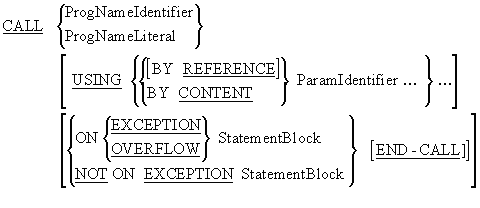
CALL notes
-
If the
CALL passes parameters, then the called
program must have a USING phrase after the
PROCEDURE DIVISION header and a
LINKAGE SECTION to describe the parameters passed.
-
The
CALL statement has a
USING phrase only if a
USING phrase is used in the
PROCEDURE DIVISION header of the called program.
-
Both
USING phrases must have the same number of
parameters.
-
Unlike languages like Modula-2, COBOL does not check the type of the parameters passed
to a called program. It is the programmer's responsibility to make sure that only
parameters of the correct type and size are passed.
-
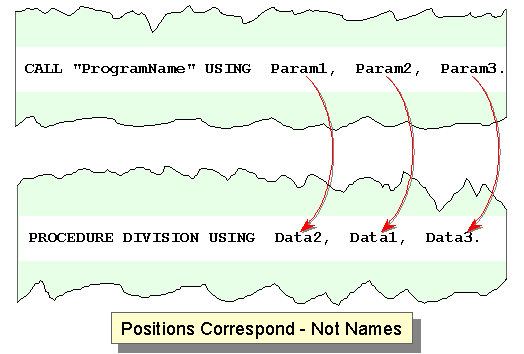
Parameters passed from the calling program to the called program correspond by position,
not by name. That is, the first parameter in the
USING phrase of the
CALL corresponds to the first in the
USING phase of the called program, and so on.
-
If the program being called has not been linked (does not exist in the executable
image,) the statement block following the
ON EXCEPTION/OVERFLOW will execute. Otherwise, the
program will terminate abnormally.
-
BY REFERENCE is the default passing mechanism, and
so is sometimes omitted.
-
Note that vendors often extend the
CALL by
introducing BY VALUE parameter passing, and by
including a GIVING phrase. These are non-standard
extensions.
In standard COBOL, the CALL verb has two parameter
passing mechanisms -
BY REFERENCE and
BY CONTENT.
-
BY REFERENCE is used when the called program needs
to pass data back to the caller.
-
BY CONTENT
is used when data needs to be passed to, but not received from, the called program.
The diagrams and explanations below show how these mechanisms work.
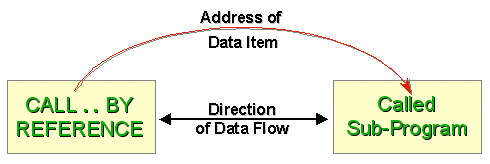
CALL..BY REFERENCE
When data is passed BY REFERENCE, the address of the
data-item is supplied to the called subprogram. So any changes made to the data-item in the
subprogram are also made to the data-item in the main program because both items refer to
the same memory location.
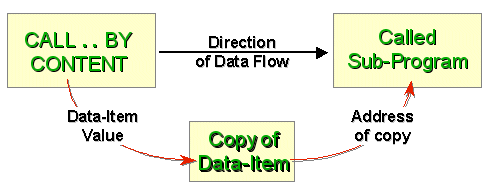
CALL..BY CONTENT
When a parameter is passed
BY CONTENT a copy of the data-item is made and the
address of the copy is supplied to subprogram. Any changes made to the data-item in the
subprogram affect only the copy.
The example fragments below show how a CALL statement is
made in a calling program to invoke and pass parameters to a subprogram (shown in outline).
CALL "DateValidate"
     USING BY CONTENT TempDate
     USING BY REFERENCE DateCheckResult.
The CALL statement in the calling program.
IDENTIFICATION DIVISION.
PROGRAM-ID DateValidate IS INITIAL.
DATA DIVISION.
WORKING-STORAGE SECTION.
          ? ? ? ? ? ? ? ? ? ? ? ?
LINKAGE SECTION.
01  DateParam            PIC X(8).
01  DateResult           PIC 9.
PROCEDURE DIVISION USING DateParam, DateResult.
Begin.
       ? ? ? ? ? ? ? ? ? ? ? ?
       ? ? ? ? ? ? ? ? ? ? ? ?
       EXIT PROGRAM.
??????.
       ? ? ? ? ? ? ? ? ? ? ? ?
Outline of the called program
Notes
Note that the name given in the
CALL statement (i.e. "DateValidate") corresponds
with the name given in the PROGRAM-ID of the called
program. The main purpose of the PROGRAM-ID clause
is to identify programs within a run-unit (i.e. a set of programs that have been
compiled and linked into one executable image) and the
CALL transfers control from one program in the
run-unit to another.
Note that the subprogram has a LINKAGE SECTION where the
parameters passed to it are defined.
Note that the names of the parameters passed by the
CALL statement in the main program are different from
those in the called subprogram. This is because it is the positions of the parameters
following their respective USING clauses that is
significant, not the names used.
In this case TempDate corresponds to DateParam and DateCheckResult to
DateResult.
TempDate is a parameter passed to the subprogram
BY CONTENT. This means that no matter what the
subprogram does to the value in the corresponding DateParam, the original value
of TempDate will be unaffected.
By contrast, DateCheckResult is passed
BY REFERENCE and this means that any changes to the
value in the corresponding DateResult are reflected by a change in value of
DateCheckResult in the main program.
Passing parameters BY REFERENCE is the mechanism by
which data is passed from a called subprogram to the main program. In this example, what is
being passed back is a code indicating the success or failure of the validation.
BY REFERENCE should be used only when you require a
subprogram to pass data back to the main program. It is a principle of modular design (i.e.
a design where the system is broken into a number of subprograms. rather than consisting of
a single monolithic program) that the data connection between modules should be as limited
as possible.
The IS INITIAL phrase
The first time a subprogram is called, it is in its initial state: all files are closed and
the data-items are initialized to their
VALUE clauses.
The next time it is called, it remembers its state from the previous call. Any files that
were opened are still open, and any data-items that were assigned values still contain those
values.
Although it can be useful for a subprogram to remember its state from call to call, systems
that contain subprograms. with "state memory" are often less reliable and more difficult to
debug than those that do not.
A subprogram can be forced into its initial state each time it is called, by including the
IS INITIAL clause in the
PROGRAM-ID.
In the examples below, the subprogram "Steadfast" produces the same result every time it is
called with the same parameter value. But "Fickle", because it remembers its state from the
previous call, will produce different results when called with the same value.
? ? ? ? ? ? ? ? ? ?
MOVE 12 TO IncrementVal.
CALL "Steadfast" USING BY CONTENT IncrementVal.

MOVE 5 TO IncrementVal
CALL "Steadfast" USING BY CONTENT IncrementVal.

MOVE 12 TO IncrementVal.
CALL "Steadfast" USING BY CONTENT IncrementVal.

? ? ? ? ? ? ? ? ? ?
MOVE 12 TO IncrementVal.
CALL "Fickle" USING BY CONTENT IncrementVal.

MOVE 5 TO IncrementVal.
CALL "Fickle" USING BY CONTENT IncrementVal.
MOVE 12 TO IncrementVal.
CALL "Fickle" USING BY CONTENT IncrementVal.
? ? ? ? ? ? ? ? ? ?
Statements in the calling program
       >>SOURCE FORMAT IS FREE
IDENTIFICATION DIVISION.
PROGRAM-ID. Steadfast IS INITIAL.
DATA DIVISION.
WORKING-STORAGE SECTION.
01 RunningTotal PIC 9(5) VALUE 50.
LINKAGE SECTION.
01 ParamValue PIC 99.
PROCEDURE DIVISION USING ParamValue.
Begin.
   ADD ParamValue TO RunningTotal.
   DISPLAY "Total = ", RunningTotal.
   EXIT PROGRAM.
Example Runs
The parameter value is shown in blue and the
result displayed is shown in red.
First Run
12
Total = 62
Second Run
5
Total = 55
Third Run
12
Total = 62
In "Steadfast", no matter how many times we run the program, when the parameter value is the
same - the result is the same. For instance, on the first and third runs of the program the
parameter has the value 12 and each time the result is 62 (12+50).
       >>SOURCE FORMAT IS FREE
IDENTIFICATION DIVISION.
PROGRAM-ID. Fickle.

DATA DIVISION.
WORKING-STORAGE SECTION.
01 RunningTotal   PIC 9(5) VALUE 50.

LINKAGE SECTION.
01 ParamValue     PIC 99.

PROCEDURE DIVISION USING ParamValue.
Begin.
   ADD ParamValue TO RunningTotal.
   DISPLAY "Total = ", RunningTotal.
   EXIT PROGRAM.
Example Runs
The parameter value is shown in blue and the
result displayed is shown in red.
First Run
12
Total = 62
Second Run
5
Total = 67
Third Run
12
Total = 79
In "Fickle" the result produced by running the program depends on what the program
"remembers" from the last time it was run. In the example runs, even though the parameter
value is the same on the first and third runs, the result produced is different. On the
first run the result is 62 (12+50) but on the third run, even though the value of the
parameter is still 12, the program "remembers" the value of
RunningTotal from the previous run and produces a result of 79 (12+67).
Sometimes a program only needs "state memory" part of the time. That is, it needs to be
reset to its initial state periodically.
In COBOL this can be done by means of the
CANCEL verb/command.
The syntax of the CANCEL verb is as follows
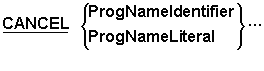
When the CANCEL command is executed, the memory space
occupied by the subprogram is freed and if the subprogram is called again it will be in its
initial state (i.e. all files closed and the data-items initialized to their
VALUE clauses).
By using the following statements in our main program
CALL "Fickle" USING BY CONTENT IncValue.
CANCEL "Fickle"
CALL "Fickle" USING BY CONTENT IncValue.
we can force "Fickle" to act like "Steadfast".
COBOL subprograms are identical to standard COBOL programs with the following exceptions:
-
The
PROGRAM-ID may take the
IS INITIAL and
IS COMMON PROGRAM clauses.
-
When parameters are passed to the subprogram, the
PROCEDURE DIVISION header of the subprogram must
have the USING phrase.
-
When there are parameters, the
DATA DIVISION of the
subprogram must have a LINKAGE SECTION where the
items specified in the USING phrase are declared.
-
The
EXIT PROGRAM statement is used where the
STOP RUN would be used in a standard COBOL
program.
An EXIT PROGRAM statement has the effect of stopping
the subprogram and returning control to the calling program.
The difference between a STOP RUN and an
EXIT PROGRAM statement is that the
STOP RUN causes the whole run-unit to stop (even if
it is encountered in a subprogram) instead of just the subprogram
-
Contained subprograms must end with the
END PROGRAM statement. The END PROGRAM statement
delimits the scope of a contained subprogram
COBOL subprograms can be independently compiled separate programs (linked into a single
executable run-unit) or they can be contained within the text of a containing program.
Contained subprograms are very similar to the procedures (or user defined functions) found
in other languages except that they are invoked with the
CALL verb and are better protected against accidental
data corruption.
-
In the procedures used in other languages all external data-items are visible within the
procedure unless they are explicitly redeclared as local data-items.
-
In COBOL's contained subprograms, no external data-items are visible within the
contained subprogram, unless this has been explicitly permitted by using the
IS GLOBAL clause in the data declaration.
When contained subprograms are used, the end of the main program, and each subprogram, is
signalled by means of the
END PROGRAM statement. This has the format:
END PROGRAM ProgramIdName.
Contained subprogram restrictions
Contained subprograms have the following restrictions:
-
Although contained subprograms can be nested, a contained subprogram can only be called
by the immediate containing program or by a subprogram at the same level.
-
Contained subprograms. can only call a subprogram at the same level if the called
program uses the
IS COMMON PROGRAM clause in its
PROGRAM-ID.
As noted above, data-items declared outside the scope of a contained subprogram cannot be
seen within the subprogram.
Sometimes however, you may want to share some data-item within a number of contained
subprograms.
For instance, in the example program fragments below, we want both of our subprograms to be
able to access the NameTable.
When we want a data-item to be seen within contained subprograms we simply follow the item
declaration with the IS GLOBAL clause.
The IS GLOBAL clause specifies that the data item is to
be visible within any subordinate contained subprograms.
      >>SOURCE FORMAT IS FREE
IDENTIFICATION DIVISION.
PROGRAM-ID. ContainerProgram.
   ? ? ? ? ? ? ? ? ?
01 NameTable IS GLOBAL.
   02 SName OCCURS 200 TIMES PIC X(20).
   ? ? ? ? ? ? ? ? ?
PROCEDURE DIVISION.
   ? ? ? ? ? ? ? ? ?
   CALL "PutToTable" USING ???
   ? ? ? ? ? ? ? ? ?
   CALL "ReportFromTable"
   ? ? ? ? ? ? ? ? ?
   EXIT PROGRAM.

IDENTIFICATION DIVISION.
PROGRAM-ID. PutToTable.
   ? ? ? ? ? ? ? ? ?
   MOVE StudName TO SName(SNum).
   ? ? ? ? ? ? ? ? ?
   EXIT PROGRAM
END-PROGRAM PutToTable.

IDENTIFICATION DIVISION.
PROGRAM-ID. ReportFromTable.
   ? ? ? ? ? ? ? ? ?
   DISPLAY "Student " SNum " = " SName(SNum).
   ? ? ? ? ? ? ? ? ?
   EXIT PROGRAM
END-PROGRAM ReportFromTable.
END-PROGRAM ContainerProgram.
Contained subprograms. seem to offer us the opportunity to create some form of Information
Hiding. For instance, it looks as though we could create an Informational Strength module as
defined by Myres (Myres, G.J. Composite/Structured Design. 1979) by hiding a table
declaration within a containing program and then allowing access to it through the contained
subprograms. (see diagram below).
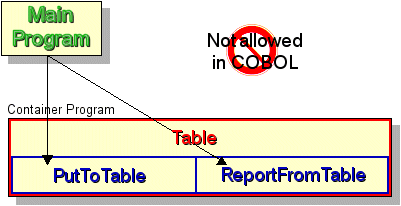
Unfortunately, this arrangement is not allowed in COBOL because, although subprograms may be
nested, a contained subprogram can only be called by the immediate containing program or by
a subprogram at the same level. So in the diagram above, the main program would not be
allowed direct access to the contained subprograms.
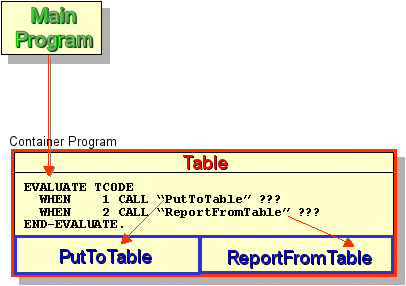
The only way any kind of Informational Strength module can be achieved is for the
MainProgram to call the ContainerProgram and for the ContainerProgram to call the
appropriate subprogram as shown below.
To do this the MainProgram would have to pass some sort of code to the ContainerProgram to
tell it which of the subprograms to use and the parameter list passed to the
ContainerProgram would have to be wide enough to accommodate the needs of the contained
subprograms. This does not cause much of a problem in the example below, but in a case where
the contained programs had more significant data needs it could prove a serious drawback.
Glenford Myres (Myres, G.J. Composite/Structured Design. 1979) has produced criteria
for deciding whether a module (i.e. a subprogram) is good or bad. Module Coupling (i.e. the
data connections between modules) is one of the criteria he considers. According to his
criteria the ContainerProgram below exhibits both Stamp and Control coupling.
A programmer pondering the problem outlined above - how to get an external program to make
direct calls to the subprograms contained within a container might be excited to come across
the
IS COMMON PROGRAM clause. He might be forgiven for
thinking for a moment that this clause was the solution to his problem. Sadly this is not
the case.
The only use of the
IS COMMON PROGRAM clause is to allow a subprogram to
call one of its sibling subprograms. (i.e. a subprogram at the same level).
Contained subprograms can only call a subprogram at the same level if the called program
uses the IS COMMON PROGRAM phrase in its
PROGRAM-ID. For instance in the example below
DisplayData is called by the main program and by its sibling InsertData but
InsertData cannot call DisplayData.
The syntax diagram for the IS INITIAL and
IS COMMON clauses is shown below. As you can see from
the diagram both the COMMON and
INITIAL clauses may be used in combination. The words
IS and PROGRAM are
noise words which may be omitted.

In this example, SharedItem can be accessed in the main program and in each of the
subprograms because this has been explicitly specified in the data declaration by using the
IS GLOBAL clause.
Note that "$ SET NESTCALL" is a compiler directive for
GnuCOBOL telling the compiler to expect contained subprograms. It is not standard COBOL.
      >>SOURCE FORMAT IS FREE
IDENTIFICATION DIVISION.
PROGRAM-ID. MainProgram.
DATA DIVISION.
WORKING-STORAGE SECTION.
01 SharedItem     PIC X(25) IS GLOBAL.
PROCEDURE DIVISION.
Begin.
    CALL "InsertData"
    MOVE "Main can also use the share" TO SharedItem
    CALL "DisplayData"
    STOP RUN.

IDENTIFICATION DIVISION.
PROGRAM-ID. InsertData.
PROCEDURE DIVISION.
Begin.
    MOVE "Shared area works" TO SharedItem
    CALL "DisplayData"
    EXIT PROGRAM.
END PROGRAM InsertData.

IDENTIFICATION DIVISION.
PROGRAM-ID. DisplayData IS COMMON PROGRAM.
PROCEDURE DIVISION.
Begin.
    DISPLAY SharedItem.
    EXIT PROGRAM
END PROGRAM DisplayData.

END PROGRAM MainProgram.
In the example below the "Fickle" and "Steadfast" subprograms are revisited. This time they
have been incorporated into the text of a main, containing program.
The first part of the main program calls "Fickle" and "Steadfast" to demonstrate the
difference between a program that has state memory and one that does not.
In the second part of the main program, "Fickle" is used with the
CANCEL command to calculate the square of a number by
repeated addition. After the square of a particular number has been calculated the
CANCEL command is used to initialize "Fickle" so that
the next number may be computed.
       >>SOURCE FORMAT IS FREE
IDENTIFICATION DIVISION.
PROGRAM-ID. Counter.
DATA DIVISION.
WORKING-STORAGE SECTION.
01 Increment      PIC 99 VALUE ZERO.
   88 EndOfData VALUE ZERO.
PROCEDURE DIVISION.
Begin.
*> Demonstrates the difference between Fickle
*> and Steadfast.  Entering a 0 ends the iteration
  DISPLAY "Enter value - " WITH NO ADVANCING.
  ACCEPT Increment.
  PERFORM UNTIL EndOfData
     CALL "Fickle"    USING BY CONTENT Increment
     CALL "Steadfast" USING BY CONTENT Increment
     DISPLAY "Enter value - " WITH NO ADVANCING
     ACCEPT Increment
  END-PERFORM.

*> Shows how CANCEL may be used to initialise
*> Fickle periodically.  Fickle is used to get the
*> square of a number by repeated addition.
  DISPLAY "Enter the value to be squared"
  DISPLAY "Value - " WITH NO ADVANCING.
  ACCEPT Increment.
  PERFORM UNTIL EndOfData
     CANCEL "Fickle"
     PERFORM Increment TIMES
       CALL "Fickle" USING BY CONTENT Increment
     END-PERFORM
     DISPLAY "Value - " WITH NO ADVANCING
     ACCEPT Increment
  END-PERFORM.
  STOP RUN.

IDENTIFICATION DIVISION.
PROGRAM-ID. Fickle.
DATA DIVISION.
WORKING-STORAGE SECTION.
01 RunningTotal   PIC 9(5) VALUE ZERO.
LINKAGE SECTION.
01 ParamValue     PIC 99.
PROCEDURE DIVISION USING ParamValue.
Begin.
  ADD ParamValue TO RunningTotal.
  DISPLAY "Fickle total    = " WITH NO ADVANCING
  CALL "DisplayTotal" USING BY CONTENT RunningTotal
  EXIT PROGRAM.
END PROGRAM Fickle.

IDENTIFICATION DIVISION.
PROGRAM-ID. Steadfast IS INITIAL.
DATA DIVISION.
WORKING-STORAGE SECTION.
01 RunningTotal PIC 9(5) VALUE ZERO.
LINKAGE SECTION.
01 ParamValue PIC 99.
PROCEDURE DIVISION USING ParamValue.
Begin.
  ADD ParamValue TO RunningTotal.
  DISPLAY "Steadfast total = " WITH NO ADVANCING
  CALL "DisplayTotal" USING BY CONTENT RunningTotal
  EXIT PROGRAM.
END PROGRAM Steadfast.

IDENTIFICATION DIVISION.
PROGRAM-ID. DisplayTotal IS COMMON INITIAL PROGRAM.
DATA DIVISION.
WORKING-STORAGE SECTION.
01 PrnTotal  PIC ZZ,ZZ9.
LINKAGE SECTION.
01 Total     PIC 9(5).
PROCEDURE DIVISION USING Total.
Begin.
  MOVE Total TO PrnTotal.
  DISPLAY PrnTotal.
  EXIT PROGRAM.
END PROGRAM DisplayTotal.
END PROGRAM Counter.
Example Run
Numeric values entered by the user are shown in
blue and values output by the computer are shown
in red.
Enter value - 13
Fickle total    = 13
Steadfast total = 13
Enter value - 3
Fickle total    = 16
Steadfast total =  3
Enter value - 13
Fickle total    = 29
Steadfast total = 13
Enter value - 0

Enter the value to be squared
Value - 8
Fickle total =  8
Fickle total = 16
Fickle total = 24
Fickle total = 32
Fickle total = 40
Fickle total = 48
Fickle total = 56
Fickle total = 64

Value - 3
Fickle total =  3
Fickle total =  6
Fickle total =  9
Value - 0
The IS GLOBAL clause allows a program and its contained
subprograms to share access to a data-item.
The IS EXTERNAL clause does the same for any subprogram
in a run-unit (i.e. any linked subprogram). But while the data-item that uses
IS GLOBAL phrase only has to be declared in one place,
each of the subprograms that wish to gain access to an
EXTERNAL shared item must declare the item in exactly
the same way.
The animation below shows how the IS EXTERNAL clause
works.
In this animation there are four programs in the run-unit. Program B and Program D wish to
communicate using a shared data. In COBOL they can do this by using the
IS EXTERNAL clause to set up a shared area of memory but
both both programs must contain the declarations below. These set up, and allow access to,
the shared area.
Example:
     WORKING-STORAGE SECTION.
     01 SharedRec IS EXTERNAL.
        02 PartA     PIC X(4).
        02 PartB     PIC 9(5).
SharedRecord
Program

The kind of hidden data communication between subprograms that is supported by the
IS EXTERNAL clause is generally regarded as very poor
practice. Myres (Myres, G.J. Composite/Structured Design. 1979), for instance,
indicates that this "Common Coupling" is nearly the worst kind of module coupling possible.
Anyone who considers creating a system that consists of subprograms and contained
subprograms should not embark on such an undertaking without a sound understanding how such
a system is designed and what makes a good subprogram and what does not.
This kind of system design is called a modular design and the subprograms are called
modules. There are a number of different methods/approaches to designing a modular system
but Structured Design is probably the most successful.
It is beyond the scope of this course to provide instruction in Structured Design but
programmers tasked with creating a modular system should read these two texts.
Page-Jones, Meilir,
Practical guide to Structured Systems Design - Second Edition,
Prentice-Hall 1988.
Myers, Glenford, Composite/Structured Design, Von Nostrand Reinhold 19
Although this course cannot provide instruction in Structured Design we can observe that the
criteria for module goodness specified in that approach boils down to three things:
-
A subprogram should perform a single specific function or should co-ordinate its
subordinate subprograms such that they perform a single function.
-
A subprogram should only be given access to the data it actually requires to do its job.
Even then, the type of access (Read-Only or Read-Write) allowed on the data should be
restricted.
-
The data passed to and from the subprogram should be passed through the parameter list
in as transparent a manner as possible - there should be no hidden method of data
transfer.